
2.1 Quadratic Equations and Inequalities
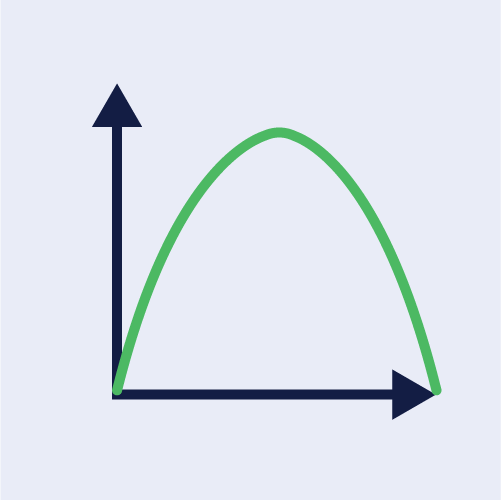
A quadratic equation is a polynomial equation where the highest power of the variable is 2. In general form, it is written as \(ax^2 + bx + c = 0\), where \(a, b,\) and \(c\) are constants and \(a \neq 0\). The solutions or roots of a quadratic equation represent the \(x\)-coordinates of the intersection points between the curve \(y = ax^2 + bx + c\) and the \(x\)-axis. Beyond basic factorisation, quadratic equations can be solved using completing the square or the quadratic formula. Furthermore, when roots are given, new quadratic equations can be formed using the sum and product of roots. Finally, quadratic inequalities can be solved using graph sketching, number line, or table methods.
Learning Objectives
- Solve quadratic equations using the method of completing the square.
- Solve quadratic equations using the quadratic formula \(x = \dfrac{-b \pm \sqrt{b^2 - 4ac}}{2a}\).
- Form quadratic equations using the sum of roots (\(\alpha + \beta\)) and product of roots (\(\alpha\beta\)).
- Solve quadratic inequalities using the graph sketching method, number line method, and table method.
Methods to Solve Quadratic Inequalities: \((x + 1)(x - 3) > 0\) vs \((x + 1)(x - 3) < 0\)
Compare graph sketching, number line and table methods to identify solution intervals.
Graph Sketching Method
Sketch an upward-opening parabola with roots \(-1\) and \(3\). For \(> 0\), choose the shaded positive wings: \(x < -1\) or \(x > 3\). For \(< 0\), choose the dip below the \(x\)-axis: \(-1 < x < 3\).
Number Line Method
Mark critical values \(-1\) and \(3\). Test points \(-2\), \(0\), and \(4\) give signs \(+\), \(-\), \(+\) across the intervals \(x < -1\), \(-1 < x < 3\), and \(x > 3\).
| Interval | \((x + 1)\) | \((x - 3)\) | Product sign |
|---|---|---|---|
| \(x < -1\) | \(-\) | \(-\) | \(+\) |
| \(-1 < x < 3\) | \(+\) | \(-\) | \(-\) |
| \(x > 3\) | \(+\) | \(+\) | \(+\) |
Short Explanation
Quadratic equations can always be written in the form \(ax^2 + bx + c = 0\).
1. General Form and Roots
General form: \(ax^2 + bx + c = 0\), where \(a, b, c\) are constants and \(a \neq 0\). The roots are values of \(x\) when \(y = 0\), which correspond to the \(x\)-intercepts of \(y = ax^2 + bx + c\).
2. Completing the Square
If \(a \neq 1\), divide both sides by \(a\) so the coefficient of \(x^2\) is 1. Move the constant term to the right-hand side, add \(\left(\dfrac{\text{coefficient of } x}{2}\right)^2\) to both sides, factorise into \((x + p)^2\), then take the square root of both sides including \(\pm\).
3. Quadratic Formula
\(x = \dfrac{-b \pm \sqrt{b^2 - 4ac}}{2a}\). Brahmagupta produced an equivalent formula: \(x = \dfrac{\sqrt{4ac + b^2} - b}{2a}\). Al-Khwarizmi used methods equivalent to completing the square.
4. Forming Equations from Roots
If \(\alpha\) and \(\beta\) are the roots: \((x - \alpha)(x - \beta) = 0 \implies x^2 - (\alpha + \beta)x + \alpha\beta = 0\).
5. Sum and Product of Roots
Sum of roots (SOR): \(\alpha + \beta = -\dfrac{b}{a}\). Product of roots (POR): \(\alpha\beta = \dfrac{c}{a}\).
6. Quadratic Inequalities
For \((x - a)(x - b) > 0\) with \(a < b\): \(x < a\) or \(x > b\). For \((x - a)(x - b) < 0\): \(a < x < b\).
| Identity | Expression |
|---|---|
| Sum of squares | \(\alpha^2 + \beta^2 = (\alpha + \beta)^2 - 2\alpha\beta\) |
| Difference squared | \((\alpha - \beta)^2 = (\alpha + \beta)^2 - 4\alpha\beta\) |
| Reciprocal sum | \(\dfrac{1}{\alpha} + \dfrac{1}{\beta} = \dfrac{\alpha + \beta}{\alpha\beta}\) |
Steps for Completing the Square
If \(a \neq 1\), divide both sides by \(a\) so the coefficient of \(x^2\) is 1.
Move the constant term to the right-hand side.
Add \(\left(\dfrac{\text{coefficient of } x}{2}\right)^2\) to both sides.
Factorise the left-hand side into \((x + p)^2\), then take square roots and solve for \(x\).
Quadratic formula
\(x = \dfrac{-b \pm \sqrt{b^2 - 4ac}}{2a}\)Use when factorisation is not simple.
Equation from roots
\(x^2 - (\text{SOR})x + (\text{POR}) = 0\)Use the sum and product of roots.
Try to Answer First
Answer in your mind, then press "Check Answer".
Solve the quadratic equation \(x^2 + 4x - 7 = 0\) by completing the square. Give the answers correct to three decimal places.
If \(\alpha\) and \(\beta\) are roots of \(2x^2 + x - 4 = 0\), form a quadratic equation with roots \(2\alpha\) and \(2\beta\).
Find the range of values of \(x\) for the inequality \(x^2 - 3x - 4 \ge 0\).
Common Mistakes
- Forgetting the negative sign in SOR: writing \(\alpha + \beta = \dfrac{b}{a}\) instead of \(-\dfrac{b}{a}\).
- Sign error when forming quadratic equations: writing \(x^2 + (\text{SOR})x + (\text{POR}) = 0\) instead of \(x^2 - (\text{SOR})x + (\text{POR}) = 0\).
- Missing \(\pm\) in completing the square: taking only the positive square root when solving \((x + p)^2 = q\), which loses one valid root.
- Combining disjoint inequality intervals incorrectly: writing an inequality like \(x < -1 \text{ or } x > 4\) as a single combined statement \(-1 > x > 4\), which is mathematically invalid.
- Dividing by a coefficient without dividing all terms: in completing the square, failing to divide the constant term by \(a\) before adding \(\left(\dfrac{b}{2a}\right)^2\).
Concept Misunderstandings
Many students believe \((x - a)(x - b) > 0\) means \((x - a) > 0\) AND \((x - b) > 0\) only.
The product of two factors is positive if both are positive OR both are negative. Hence, \(x > b\) (both positive) or \(x < a\) (both negative).
Thinking that the roots of an equation change when the entire equation is multiplied by a non-zero constant.
Multiplying both sides of \(ax^2 + bx + c = 0\) by a constant \(k \neq 0\) changes the coefficients, but the roots remain unchanged.
Assuming that completing the square can only be used when the coefficient of \(x^2\) is 1.
It can be used for any quadratic equation, but you must first divide the entire equation by \(a\) so that the coefficient of \(x^2\) becomes 1.
Summary
- The general form of a quadratic equation is \(ax^2 + bx + c = 0\), where \(a \neq 0\).
- Solutions can be obtained using completing the square: transform into \((x + p)^2 = q\) and solve.
- Quadratic formula: \(x = \dfrac{-b \pm \sqrt{b^2 - 4ac}}{2a}\).
- For roots \(\alpha\) and \(\beta\): SOR \(= \alpha + \beta = -\dfrac{b}{a}\), POR \(= \alpha\beta = \dfrac{c}{a}\), and equation \(x^2 - (\text{SOR})x + (\text{POR}) = 0\).
- For \((x - a)(x - b) = 0\) with \(a < b\): \((x - a)(x - b) > 0 \implies x < a \text{ or } x > b\); \((x - a)(x - b) < 0 \implies a < x < b\).
Short Activity
Objective: Test your understanding of roots, formulas and inequality solution rules.
A. Objective Quiz
1 What is the sum of roots for the quadratic equation \(3x^2 - 9x + 5 = 0\)?
2 Which of the following is the solution range for the quadratic inequality \((x + 2)(x - 5) < 0\)?
B. Fill in the Blanks
3 In general form, the formula used to calculate the product of roots \(\alpha\beta\) from \(ax^2 + bx + c = 0\) is ________.
4 When solving a quadratic equation by completing the square after ensuring the coefficient of \(x^2\) is 1, the term added to both sides of the equation is the square of half the ________ of \(x\).
C. Matching / Drag and Drop
Match each mathematical concept or inequality form to its correct formula or solution rule. On a phone, tap a term first, then tap the matching box.

